“Il giorno in cui John incontrò Paul”
“The Day John Met Paul”
🇮🇹 Italiano
Non c’erano luci di scena, né folle urlanti.
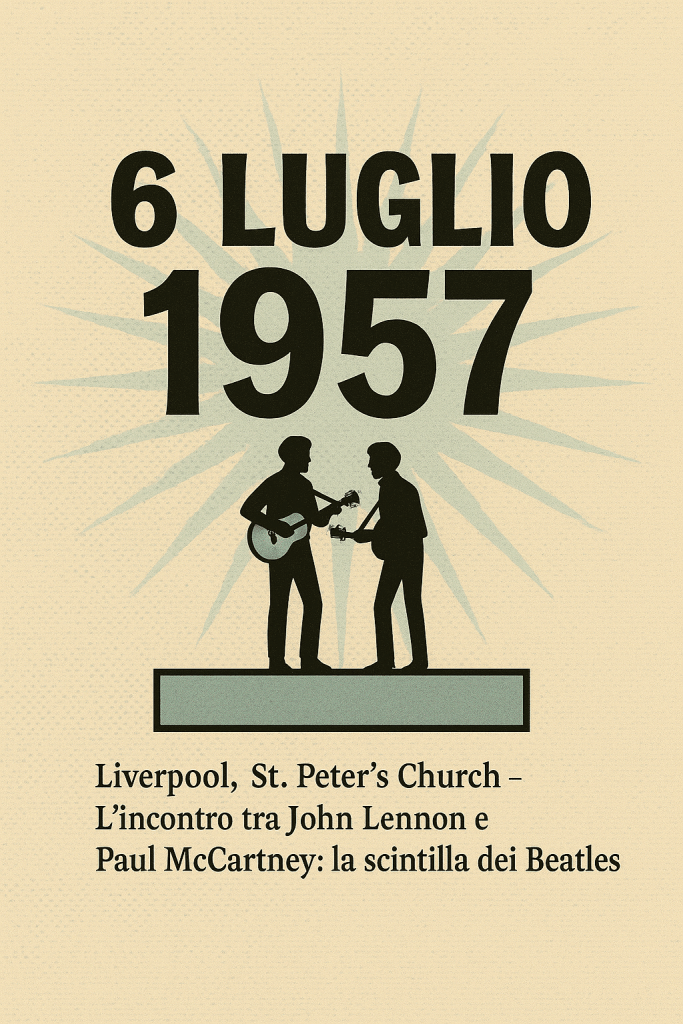
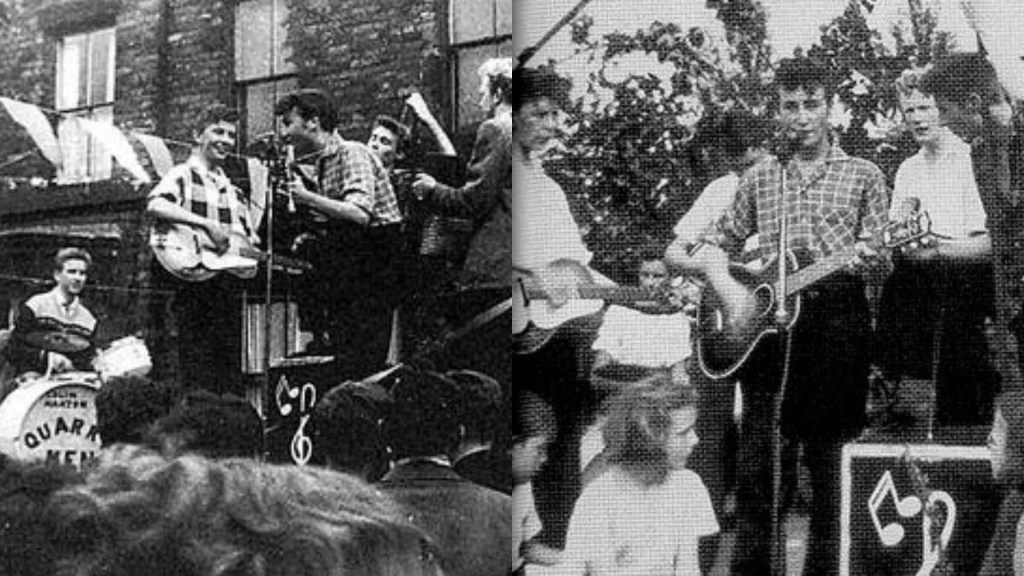
C’era un piccolo palco improvvisato nel giardino della St. Peter’s Church di Woolton, un sobborgo di Liverpool. Era il 6 luglio 1957, e un ragazzo di sedici anni, John Lennon, stava suonando con i suoi Quarrymen. Aveva lo sguardo ribelle, la camicia bianca arrotolata sulle braccia e un’energia che sembrava voler sfidare il mondo intero. La sua musica era ancora acerba, sospesa tra lo skiffle che andava di moda nei cortili operai e il rock’n’roll che stava travolgendo l’America.
Liverpool, allora, era lontanissima dai riflettori del mondo. Una città portuale, segnata dalle bombe della guerra, piena di magazzini, di nebbia e di sogni che spesso si fermavano sul molo. Ma proprio lì, tra i baracconi di mattoni rossi e i vicoli pieni di ragazzi scalmanati, la musica era diventata un linguaggio di sopravvivenza. Per Lennon e i suoi amici, suonare non era un passatempo: era un modo per dire “noi ci siamo”, per non farsi inghiottire dal grigiore quotidiano.
🇬🇧 English
There were no stage lights, no screaming crowds.
Just a small improvised stage in the garden of St. Peter’s Church in Woolton, a suburb of Liverpool. It was July 6, 1957, and a sixteen-year-old John Lennon was playing with his band, the Quarrymen. He had a rebellious look, sleeves rolled up on his white shirt, and an energy that seemed ready to challenge the whole world. His music was still raw, suspended somewhere between the skiffle popular in working-class courtyards and the rock’n’roll sweeping in from America.
Liverpool, at that time, was far from the spotlight. A port city scarred by bombs from the war, filled with warehouses, fog, and dreams that often ended at the docks. Yet there, among the red-brick warehouses and alleys full of noisy kids, music had become a language of survival. For Lennon and his friends, playing wasn’t a hobby: it was a way of saying “we are here”, a way not to be swallowed by the grey of everyday life.
🇮🇹 Italiano
“Liverpool, 6 luglio 1957 – I Quarrymen sul palco della St. Peter’s Church. Quel giorno John Lennon incontrò Paul McCartney: nacque la scintilla destinata a diventare i Beatles.”
I Quarrymen, quel giorno, facevano del loro meglio con strumenti sgangherati: un banjo, una chitarra, un lavatoio trasformato in contrabbasso. Il pubblico era fatto di ragazzi e ragazze, gente del quartiere, curiosi che si fermavano più per l’energia che non per la perfezione musicale. Lennon, con il suo carisma naturale, teneva insieme la band come un capitano un po’ sbruffone ma irresistibile.
Tra il pubblico, però, c’era un ragazzo diverso dagli altri: Paul McCartney, quindici anni, giacca troppo grande per la sua età, e una chitarra che teneva come fosse un’estensione del suo corpo. Paul non era lì solo per divertirsi. Osservava con attenzione ogni gesto, ogni accordo, ogni sbavatura. Sapeva riconoscere quando qualcuno stava improvvisando e quando invece c’era controllo.
Alla fine dell’esibizione, un amico comune li presentò. Lennon, ancora sudato e con la chitarra in mano, guardò Paul con aria di sfida. McCartney non perse tempo: accordò lo strumento e, davanti a lui, attaccò “Twenty Flight Rock” di Eddie Cochran. La suonò con sicurezza, cantando senza esitazioni, infilando perfino un piccolo giro di accordi in più che fece alzare le sopracciglia a John.
Non fu solo bravura tecnica. Fu l’atteggiamento. Paul dimostrava disciplina, precisione, memoria musicale. Lennon, che odiava sembrare inferiore, capì subito che quel ragazzo poteva essere un pericolo… ma anche un alleato. “Questo qui ci sa fare”, pensò. Non lo disse a voce, ma quel giorno nacque qualcosa che avrebbe cambiato la musica per sempre.
🇬🇧 English
“Liverpool, July 6, 1957 – The Quarrymen on stage at St. Peter’s Church. That day John Lennon met Paul McCartney: the spark that would become the Beatles was lit.”
That day the Quarrymen did their best with their ramshackle instruments: a banjo, a guitar, a washboard turned into a bass. The audience was made up of local boys and girls, neighbors and curious passers-by who stopped more for the energy than for the musical precision. Lennon, with his natural charisma, held the band together like a cocky yet irresistible captain.
But in the crowd there was a boy who was different: Paul McCartney, fifteen years old, wearing an oversized jacket, holding his guitar as if it were an extension of himself. Paul wasn’t just there for fun. He watched every move, every chord, every slip. He could tell when someone was improvising and when they were in control.
At the end of the performance, a mutual friend introduced them. Lennon, still sweating and holding his guitar, looked at Paul with a challenging stare. Paul wasted no time: he tuned his guitar and launched into “Twenty Flight Rock” by Eddie Cochran. He played it confidently, singing without hesitation, even throwing in an extra chord change that raised John’s eyebrows.
It wasn’t just technical skill. It was attitude. Paul showed discipline, precision, and musical memory. Lennon, who hated to seem inferior, realized immediately that this boy could be a threat… but also an ally. “This one’s got it,” he thought. He didn’t say it out loud, but that day something was born that would change music forever.
🇮🇹 Italiano
Due caratteri opposti, una stessa urgenza
John e Paul non erano fatti per somigliarsi.
Lennon era istinto puro, ironia tagliente, spirito ribelle. Non studiava con regolarità, preferiva scrivere versi nonsense e inventare storie nei quaderni. Cresciuto con la zia Mimi, aveva imparato presto a cavarsela da solo, oscillando tra il dolore della perdita della madre Julia e il bisogno di sembrare sempre il più forte del gruppo.
Paul, invece, era metodo e armonia. Suo padre, Jim, suonava in una jazz band amatoriale; la casa dei McCartney era piena di musica. Paul aveva assorbito melodie e armonie fin da bambino, imparando a trascrivere mentalmente i brani che ascoltava. Era un perfezionista naturale: se John rappresentava il fuoco, Paul era l’acqua che lo sapeva domare senza spegnerlo.
L’incontro dei due fu una collisione di mondi: l’istinto creativo e la disciplina, il sarcasmo e la dolcezza melodica, il caos e l’ordine. Due poli opposti che, proprio per questo, finirono per attrarsi.
🇬🇧 English
Two Opposite Characters, One Same Urge
John and Paul were not made to resemble each other.
Lennon was pure instinct, sharp irony, rebellious spirit. He didn’t study regularly, he preferred to scribble nonsense verses and invent stories in his notebooks. Raised by his Aunt Mimi, he had learned early on to fend for himself, swinging between the pain of losing his mother Julia and the need to appear the strongest in the group.
Paul, on the other hand, was method and harmony. His father, Jim, played in an amateur jazz band; the McCartney home was filled with music. Paul absorbed melodies and harmonies from childhood, learning to mentally transcribe the songs he heard. He was a natural perfectionist: if John was fire, Paul was water—capable of taming it without extinguishing it.
Their meeting was a collision of worlds: raw instinct and discipline, sarcasm and melodic sweetness, chaos and order. Two opposite poles that, precisely for this reason, ended up attracting each other.
🇮🇹 Italiano
Liverpool: il terreno fertile
Per capire la potenza di quella scintilla, bisogna immaginare Liverpool nel 1957. Una città di marinai, immigrati e commerci. Nei pub del porto arrivavano dischi americani che altrove in Inghilterra non si sentivano ancora: Elvis Presley, Chuck Berry, Little Richard. I ragazzi li ascoltavano, li copiavano, li sognavano.
Lo skiffle, genere popolare e facile da suonare con strumenti di fortuna, aveva aperto la strada a centinaia di band giovanili. Ma dietro quella moda c’era già la voglia di qualcosa di più. John e Paul, senza ancora saperlo, erano pronti a spingersi oltre: a trasformare il ritmo travolgente del rock’n’roll in qualcosa di personale, radicato nella loro esperienza ma capace di parlare al mondo.
🇬🇧 English
Liverpool: The Fertile Ground
To understand the power of that spark, you need to picture Liverpool in 1957. A city of sailors, immigrants, and trade. In the pubs of the port arrived American records that weren’t yet heard elsewhere in England: Elvis Presley, Chuck Berry, Little Richard. The local kids listened, copied, and dreamed.
Skiffle, a popular genre easy to play with makeshift instruments, had opened the way for hundreds of youth bands. But behind that craze was already the hunger for something more. John and Paul, without knowing it yet, were ready to push further: to turn the driving rhythm of rock’n’roll into something personal, rooted in their experience yet able to speak to the world.
🇮🇹 Italiano
Dopo l’incontro
Nei giorni successivi, i Quarrymen discussero se accettare Paul nel gruppo. Alcuni erano scettici: “È troppo giovane”, dicevano. Ma John, che all’apparenza faceva finta di non curarsene, dentro sapeva già la verità: senza quel ragazzo, i Quarrymen sarebbero rimasti un gioco da cortile. Con lui, potevano diventare una band vera.
Così, Paul fu invitato a unirsi. Non era ancora amicizia profonda, ma una sorta di patto tacito: insieme avrebbero potuto creare qualcosa di unico. Paul iniziò a portare nuove canzoni, Lennon a limare i suoi testi. Nacque una collaborazione che presto avrebbe attirato altri ragazzi con lo stesso fuoco negli occhi.
🇬🇧 English
After the Meeting
In the following days, the Quarrymen debated whether to accept Paul into the group. Some were skeptical: “He’s too young,” they said. But John, who outwardly pretended not to care, already knew the truth inside: without that boy, the Quarrymen would remain a backyard game. With him, they could become a real band.
So Paul was invited to join. It wasn’t yet deep friendship, but a kind of tacit pact: together they could create something unique. Paul began bringing new songs, Lennon refined his lyrics. A collaboration was born that would soon attract other boys with the same fire in their eyes.
🇮🇹 Italiano
Il seme dei Beatles
Il 1957 non vide ancora nascere i Beatles. Ma vide nascere la loro anima: l’unione di Lennon e McCartney, due adolescenti che, senza saperlo, stavano dando forma alla più prolifica partnership musicale del ventesimo secolo.
Da quel piccolo palco di Woolton al mondo intero, il passo sembrava impossibile. Eppure, in quella giornata d’estate, con un sole incerto e due chitarre che suonavano stonate, iniziò davvero la leggenda.
Non erano ancora pronti, non avevano ancora George Harrison, né Ringo Starr. Ma il nucleo creativo era stato acceso. E come tutte le scintille destinate a diventare incendio, bastava aspettare: il fuoco avrebbe preso.
🇬🇧 English
The Seed of the Beatles
1957 did not yet see the birth of the Beatles. But it did witness the birth of their soul: the union of Lennon and McCartney, two teenagers who, without realizing it, were shaping the most prolific musical partnership of the twentieth century.
From that small stage in Woolton to the whole world, the leap seemed impossible. Yet, on that summer day, under a hesitant sun and with two out-of-tune guitars, the legend truly began.
They weren’t ready yet, they didn’t yet have George Harrison or Ringo Starr. But the creative core had been lit. And like all sparks destined to become a blaze, it was only a matter of time before the fire caught.
🇮🇹 Italiano
Conclusione del Capitolo
Il 6 luglio 1957 non rimase solo una data segnata sui calendari di Liverpool. Fu il giorno in cui due ragazzi comuni, in una città periferica, iniziarono a cambiare la storia della musica senza nemmeno rendersene conto.
Quando John guardò Paul suonare Twenty Flight Rock, vide in lui qualcosa che somigliava a se stesso: la fame di andare oltre. Quando Paul vide John guidare i Quarrymen con quella forza sfrontata, riconobbe il coraggio che gli mancava.
Da quel momento in poi, i loro destini furono intrecciati.
E se i Beatles sono diventati “quattro ragazzi che hanno cambiato il mondo”, è perché tutto partì da lì: da una chitarra, una canzone americana, e un incontro in un pomeriggio d’estate a Liverpool.
🇬🇧 English
Chapter Conclusion
July 6, 1957 did not remain just a date on Liverpool’s calendars. It was the day two ordinary boys, in a provincial city, began to change the history of music without even realizing it.
When John watched Paul play Twenty Flight Rock, he saw in him something that resembled himself: the hunger to go beyond. When Paul saw John leading the Quarrymen with that brash force, he recognized the courage he lacked.
From that moment on, their destinies were intertwined.
And if the Beatles became “four boys who changed the world”, it is because it all started there: with a guitar, an American song, and a meeting on a summer afternoon in Liverpool.
 Sotto il Cielo