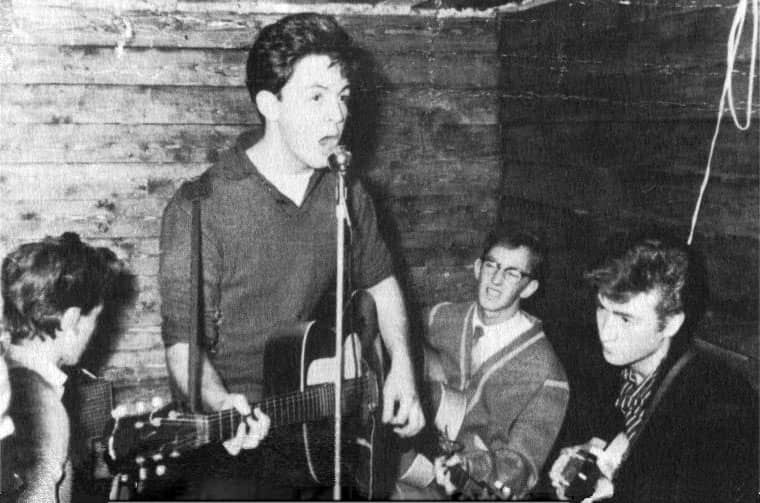
Liverpool non era Londra, non era Parigi, non era New York. Era una città operaia, segnata dalle bombe della guerra e dai sogni di chi partiva per mare. I ragazzi crescevano tra strade grigie, pub fumosi e canzoni americane che arrivavano in vinile dentro le stive delle navi mercantili.
In quell’ambiente, John Lennon si muoveva come un corpo estraneo. Non aveva nessuna intenzione di adattarsi. Non voleva obbedire alla scuola, né ai consigli degli adulti, né a un destino che sembrava già scritto. Il suo motto silenzioso, che trapelava da ogni gesto, poteva essere riassunto così:
“Non sono venuto qui per obbedire. Sono venuto per capire.”
Capire come funzionava la musica, capire come vivere senza lasciarsi stritolare dalle regole, capire fin dove poteva spingersi la sua ribellione.
L’arrivo di George Harrison
Dopo l’incontro con Paul McCartney nel 1957, i Quarrymen iniziarono a cambiare pelle. Non erano più una band improvvisata di skiffle. Paul portava precisione, arrangiamenti, nuove canzoni. E presto arrivò un altro ragazzo: George Harrison, quattordicenne, più giovane di tutti, silenzioso e timido.
Era piccolo d’età, ma enorme nel talento: con la sua chitarra riusciva a fare cose che John e Paul ancora non padroneggiavano. Lennon esitò: “È troppo giovane,” pensava. Ma quando lo sentì suonare, capì che non poteva lasciarselo scappare. George entrò così nel gruppo: il terzo tassello del mosaico.
Liverpool di notte: i primi locali
Suonare nei giardini e alle feste parrocchiali non bastava più. I ragazzi cercavano spazi veri, un pubblico diverso. Cominciarono così a esibirsi in piccoli club della città, spesso davanti a gente che beveva, parlava, rideva. Non c’era Beatlemania: c’erano sguardi diffidenti, fischi, e la necessità di conquistare ogni applauso.
- The Jacaranda Club (dal 1958)
Un locale gestito da Allan Williams, impresario che sarebbe diventato il loro primo manager. Il Jacaranda era il ritrovo degli studenti d’arte, un posto rumoroso e colorato, pieno di ragazzi che volevano uscire dagli schemi. Lennon e i suoi ci andarono spesso, non solo per suonare: era lì che respiravano un’aria diversa, più internazionale, e stringevano i primi contatti che li avrebbero portati fuori da Liverpool. - Wilson Hall e Casanova Club
Erano sale da ballo dei quartieri popolari. Qui i Quarrymen provarono a spingersi oltre lo skiffle, iniziando a infilare pezzi rock’n’roll nel repertorio. Il pubblico non faceva sconti: se la band non teneva il ritmo, arrivavano fischi e risate. Proprio lì impararono che la musica non era solo entusiasmo: era disciplina, resistenza, capacità di affrontare i momenti difficili.
Il Casbah Coffee Club
Nell’estate del 1959 accadde qualcosa che cambiò la loro traiettoria. Mona Best, madre di Pete Best (futuro batterista del gruppo), decise di aprire un club nel seminterrato della sua casa: il Casbah Coffee Club.
Prima dell’inaugurazione, chiese ai ragazzi di darle una mano: John, Paul e George imbracciarono pennelli e vernice, dipinsero le pareti di nero e argento, disegnarono stelle e sagome. Quando finalmente il club aprì, furono proprio loro ad avere l’onore di suonare.
Il Casbah non era grande, non era elegante, non era famoso. Ma per i tre ragazzi divenne una casa musicale: un luogo fisso dove provare, sbagliare, ripetere, migliorare. Lì sentirono per la prima volta cosa significava avere un pubblico che tornava apposta per loro. Lì capirono che non erano più solo un gruppo improvvisato, ma una band che poteva crescere.
Ribellione e disciplina
John continuava a essere il ribelle. All’Art College di Liverpool passava più tempo a ridere e disegnare caricature che a seguire le lezioni. Ma la sua ribellione non era vuota: leggeva, osservava, si nutriva di tutto ciò che poteva trasformare in parole e in canzoni.
Paul, al contrario, si dedicava alla precisione: passava ore a trascrivere i brani che ascoltava alla radio, imparava armonie, studiava accordi. George, silenzioso, seguiva il filo della sua chitarra, cercando di renderla ogni giorno più limpida.
Tre caratteri diversi, tre strade che si incrociavano. Tutti mossi da un unico impulso: capire.
Verso Amburgo
Fu al Jacaranda, proprio grazie ad Allan Williams, che i Beatles sentirono parlare di Amburgo. I club tedeschi cercavano band inglesi disposte a suonare per ore ogni notte. Non era un contratto dorato, ma una sfida vera.
John non esitò. Non gli importava della fatica, del poco denaro, della lontananza. Lui non voleva obbedire al destino che Liverpool sembrava offrire: voleva andare a vedere cosa c’era oltre.
Così, alla fine del 1960, con strumenti consumati e più entusiasmo che esperienza, i Beatles si prepararono a partire. Non sapevano ancora che la Germania li avrebbe trasformati da ragazzi di quartiere in una vera band.
Conclusione del Capitolo
Tra il 1958 e il 1960 i Beatles passarono dall’essere una comitiva di adolescenti con chitarre scordate a un gruppo con un’identità. Lo fecero nei pub fumosi, nei club improvvisati, nelle sale da ballo affollate. Lo fecero soprattutto al Casbah Coffee Club, che divenne la loro prima casa.
“Non sono venuto qui per obbedire. Sono venuto per capire.”
Era l’anima di John, ma anche la spinta silenziosa che muoveva tutti e tre.
La scintilla del 1957 stava diventando fiamma. E quella fiamma, presto, sarebbe esplosa ad Amburgo.
Chapter 2 – Liverpool, 1958-1960: I Did Not Come Here to Obey. I Came to Understand
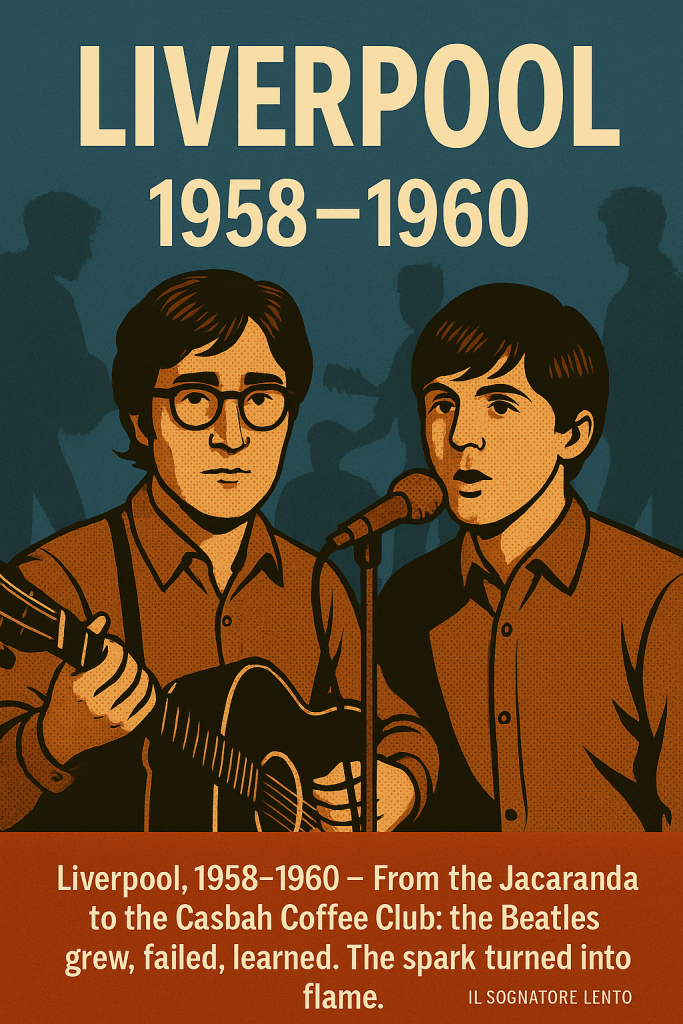
Liverpool was not London, not Paris, not New York. It was a working-class city, scarred by wartime bombs and by the dreams of those who sailed away. Kids grew up in grey streets, smoky pubs, and with American records arriving in the holds of merchant ships.
In that environment, John Lennon moved like a misfit. He had no intention of adapting. He didn’t want to obey school, the advice of adults, or a fate that seemed already written. His silent motto, revealed in every gesture, could be summed up like this:
“I did not come here to obey. I came to understand.”
To understand how music worked, to understand how to live without being crushed by rules, to understand how far his rebellion could go.
The Arrival of George Harrison
After John met Paul McCartney in 1957, the Quarrymen began to change skin. They were no longer just a skiffle band. Paul brought precision, arrangements, and new songs. And soon another boy joined: George Harrison, only fourteen, the youngest, quiet and shy.
He was young, but his talent was immense: with his guitar he could do things John and Paul hadn’t mastered yet. Lennon hesitated—“He’s too young,” he thought. But when he heard him play, he realized he couldn’t let him slip away. George became the third piece of the puzzle.
Liverpool by Night: The First Venues
Playing in gardens and parish halls was no longer enough. The boys sought real spaces, a different audience. So they began performing in small city clubs, often in front of people drinking, talking, laughing. There was no Beatlemania: only skeptical looks, whistles, and the need to win every single clap.
- The Jacaranda Club (from 1958)
Run by Allan Williams, who would become their first manager. The Jacaranda was the hangout for art students, a noisy, colorful place full of young people wanting to break out of the mold. Lennon and the others often went there, not only to play: it was where they breathed a different, more international air, and where they made the first contacts that would eventually take them out of Liverpool. - Wilson Hall and Casanova Club
Dance halls in working-class neighborhoods. Here the Quarrymen began slipping rock’n’roll songs into their set. The audience was tough: if the band lost rhythm, the whistles and jeers came fast. It was here they learned that music wasn’t just enthusiasm—it was discipline, stamina, the ability to face hard moments.
The Casbah Coffee Club
In the summer of 1959 something happened that changed their path. Mona Best, mother of Pete Best (future drummer of the band), decided to open a club in the basement of her house: the Casbah Coffee Club.
Before the opening, she asked the boys to help her: John, Paul, and George grabbed brushes and paint, covered the walls in black and silver, and painted stars and shapes. When the club finally opened, it was they who had the honor of playing first.
The Casbah wasn’t big, elegant, or famous. But for the three boys it became a musical home: a steady place to rehearse, to fail, to repeat, to improve. It was there they first felt what it meant to have an audience coming back just for them. It was there they realized they were no longer just an improvised group, but a band that could grow.
Rebellion and Discipline
John remained the rebel. At Liverpool Art College he spent more time laughing and drawing caricatures than following lessons. But his rebellion wasn’t empty: he read, observed, absorbed everything he could transform into words and songs.
Paul, on the other hand, was the precise one: he spent hours transcribing songs from the radio, learning harmonies, studying chords. George, silent, followed his guitar’s path, making its sound cleaner every day.
Three different characters, three paths crossing. All driven by a single urge: to understand.
Toward Hamburg
It was at the Jacaranda, thanks to Allan Williams, that the Beatles first heard of Hamburg. German clubs were looking for English bands ready to play for hours every night. It wasn’t a golden contract, but it was a real challenge.
John didn’t hesitate. He didn’t care about the fatigue, the little money, the distance. He didn’t want to obey the fate Liverpool seemed to offer: he wanted to see what lay beyond.
So, at the end of 1960, with worn-out instruments and more enthusiasm than experience, the Beatles prepared to leave. They didn’t yet know that Germany would turn them from neighborhood boys into a real band.
Chapter Conclusion
Between 1958 and 1960 the Beatles went from being a group of teenagers with out-of-tune guitars to a band with an identity. They did it in smoky pubs, makeshift clubs, crowded dance halls. Above all, they did it at the Casbah Coffee Club, which became their first home.
“I did not come here to obey. I came to understand.”
It was John’s spirit, but also the silent drive pushing all three.
The spark of 1957 was turning into flame. And that flame would soon blaze in Hamburg.

 Sotto il Cielo