The Golden Carnival Sweet from Abruzzo
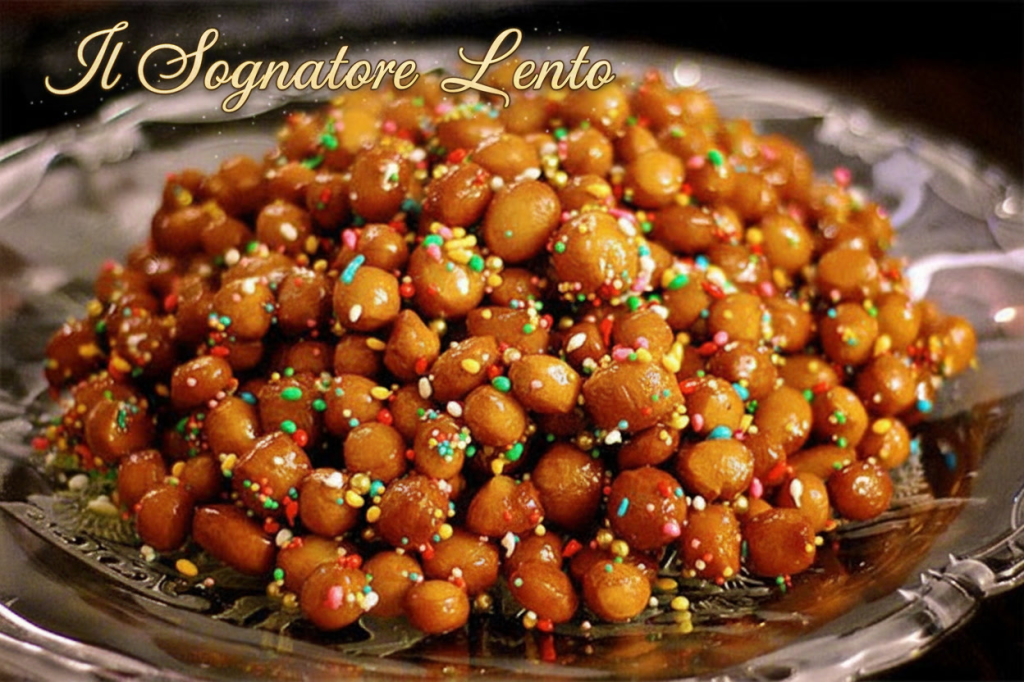
In Abruzzo, when Carnival is approaching and the scent of honey begins to fill the air, there is one dessert that announces the most joyful celebration of the year: cicerchiata.
A golden weave of tradition, patience, and sweetness, shining on the serving plate like a small treasure. Its tiny golden spheres — the “cicerchie” — resemble an ancient seed, a symbol of abundance and rebirth.
Born in the kitchens of the Sangro area, where beekeeping is a treasured craft passed down through generations and honey flows like a precious gift, cicerchiata represents the perfect bond between land and celebration: a humble dessert that honors the work of bees, the skilled hands of women, and the shared happiness of Carnival.
🧺 Ingredients
- 240 g all-purpose flour
- 2 whole eggs
- 2 tablespoons extra virgin olive oil
- 20 g sugar
- 1 tablespoon dry white wine
- Extra virgin olive oil for frying
- 100 g Abruzzese mountain honey
- 100 g sugar
- 1 tablespoon extra virgin olive oil (for the caramel)
- Toasted chopped almonds or colorful sprinkles, for decoration
🍳 Preparation
Place the flour on a work surface and make a well in the center. Add the eggs, sugar, olive oil, and white wine. Knead energetically until the dough becomes firm and smooth, then cover it and let it rest for about ten minutes.
Divide the dough into small portions and, as you would with bread dough, roll each piece into thin ropes, about the thickness of a pencil. Cut into small pieces and shape them with your fingers into tiny balls: these will be your “cicerchie.”
Fry them in hot oil until golden, then drain and place on absorbent paper.
In a large pan, melt the honey with the sugar and one tablespoon of olive oil. When the mixture turns a beautiful amber color, add the fried balls and stir with a wooden spoon so that the honey embraces each one.
Immediately transfer everything onto a lightly wet plate and, with damp hands, shape it: a golden ring, or several small individual mounds.
Decorate with almonds or colorful sprinkles — Carnival is a feast for the eyes as well.
👀 Visual Examination
Cicerchiata appears as a small masterpiece of light: an intricate weave of golden, glossy, uniform spheres, held together by honey in an amber symphony of reflections.
Its surface is shiny, slightly irregular yet harmonious, with shades ranging from wheat-gold to caramel bronze.
If decorated with colorful sprinkles or toasted almonds, it becomes lively and festive — like a Carnival mosaic.
In individual portions, the little balls remain distinct and crisp; in the ring shape, the honey creates a glassy effect that invites you to cut into it and discover its fragrant heart.
👃 Aromatic Examination
On the nose, cicerchiata releases a sweet, enveloping fragrance, capable of filling the room with its honest simplicity.
Warm honey dominates, with floral and resinous notes, while in the background emerge hints of toasted almonds, caramelized sugar, and a light scent of clean frying — almost buttery.
Closing your eyes, you can smell an old-fashioned home and celebration: the memory of desserts made together, the wooden table, and the perfume that announces Carnival before you even see it arrive.
👅 Taste Examination
On the palate, cicerchiata reveals a surprising balance: the initial crunch of the tiny spheres slowly gives way to the golden softness of the honey that coats them.
The sweetness is full but never cloying — honey, the discreet protagonist, melts into the gentle savoriness of the dough and the toasted note of frying, creating a round and harmonious sensation.
Every bite is a small journey through textures and memories: first the crisp sound, then the warm sweetness spreading through the mouth, leaving a gentle lingering finish, perfumed with honey and almond.
🍷 Flavor Profile & Pairing
Cicerchiata is a dessert that speaks the language of joy, yet it does so with the depth of time and the wisdom of artisan tradition. Every golden ball is a small fragment of celebration: crisp on the outside, tender within, glazed with honey and heritage.
Its flavor is warm and radiant: the sweetness of honey meets the roundness of extra virgin olive oil, the delicate aroma of white wine, and the toasted touch of frying. The result is a perfect balance between sweetness and fragrance, where each bite tells the story of rural simplicity and the warmth of Carnival kitchens.
The pairing works best by harmony, because honey and natural sugars find their ideal echo in sweet, aromatic regional wines. Among them stand out Passito d’Abruzzo, sweet Malvasia, and above all Moscato di Castiglione a Casauria, whose aromas of orange blossom, dried figs, and acacia honey enhance the roundness and elegance of cicerchiata.
On the palate, the wine embraces the dessert in a soft and lingering union: nothing dominates, everything blends.
It is the very essence of Abruzzese Carnival — a shared sweetness made of honey, celebration, and memory.
Se vuoi, ti preparo anche una versione più corta (da Facebook/Instagram) in inglese, con 2 righe e invito a leggere l’articolo.
mi devi dire in inglese -per i vostri nipoti che magari parlano poco italiano
Certo Nicola 😊 ecco la frase in inglese, perfetta da inserire:
“For your grandchildren, who may not speak much Italian.”
Varianti un po’ più calde (se vuoi scegliere):
- “For your grandchildren, who may not speak Italian very well.”
- “For your grandchildren, who might speak only a little Italian.”
- “So even your grandchildren—who may speak little Italian—can enjoy it too.”
la ricetta in inglese
Perfetto Nicola 😊
Ecco una frase chiara e bella da scrivere:
“The recipe is in English too — for your grandchildren, who may not speak much Italian.” 🇺🇸🇦🇺✨
Oppure più semplice:
“The recipe is also available in English, for your grandchildren who speak little Italian.”
 Sotto il Cielo
Lascia un commento