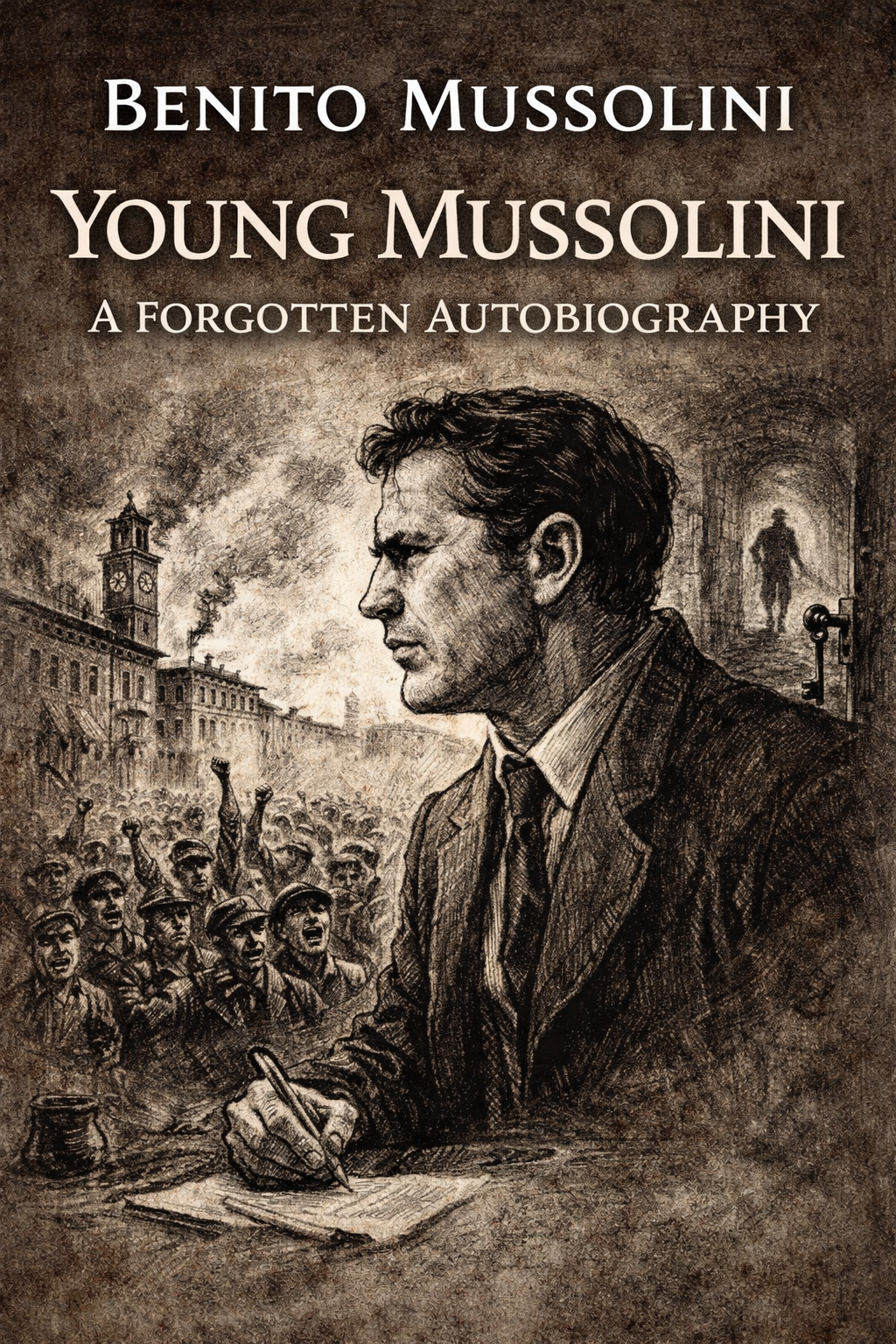

(Forlimpopoli – Switzerland, 1901–1903)
The diploma arrived the way certain things arrive that are supposed to bring order to life:
with a sheet of paper, a signature, a stamp.
Rosa held it as one holds something fragile.
She looked at it for a long time without speaking, and when she finally raised her eyes, her skin shone, as if joy itself hurt.
“Teacher,” she whispered.
Benito stood in the doorway, leaning against the frame.
He did not smile.
Not because he was unhappy.
But because the word teacher did not taste the same to him as it did to his mother.
For Rosa, teacher meant salvation: clean work, a regular life, a place in society.
For Benito, teacher meant a closed room with twenty children in front of him and authority above him.
And authority above him was something he had never digested.
Alessandro came in from the forge with blackened hands and the smell of iron clinging to him.
He looked at the paper, then at his son.
“And now?” he asked.
Rosa answered for Benito.
“Now he works.”
Her voice trembled slightly. “Now he settles down.”
Alessandro made a sound that could have been a laugh or a cough.
“Settles down…” he repeated.
Then more quietly: “And who’s going to settle this one?”
Benito met his gaze.
“I’ll settle myself.”
Alessandro nodded, as if he had heard the most natural thing in the world.
Rosa stiffened.
“Don’t talk like that. You have a duty.”
Benito clenched his jaw.
At their house, duty always had the same face: Rosa’s.
The first school was a low building, with a dirt courtyard and windows that seemed to look down as well.
Pieve Salutare was a place that asked for nothing and promised nothing.
A village where people were born, worked, and died without making much noise.
Benito arrived with a light suitcase and a coat that pulled tight across his shoulders.
The headmaster greeted him with a polite smile, already tired.
“You are Mussolini.”
Benito nodded.
“Young,” the man said, looking at him the way one looks at a new chair that might break soon.
Benito said nothing.
The headmaster led him to the classroom.
“These are the children.”
Benito entered.
The children stared at him.
Wide eyes, dirty faces, red noses.
A silence full of curiosity.
Benito stopped behind the desk.
He felt no tenderness.
He felt a sudden irritation.
Because in those eyes he saw something that frightened him:
the possibility of failing in front of someone who bore no blame.
“Sit down,” he said.
The word came out hard—harder than he intended.
The children sat.
Benito picked up the chalk.
He wrote his name on the blackboard.
MUSSOLINI
The chalk squeaked.
A child in the front row raised his hand.
“Teacher…”
Benito stared at him.
“What is it?”
The child hesitated.
“You… you’re the one who was thrown out by the priests?”
A small giggle ran through the room, like a spark.
Benito froze.
For a moment the chalk snapped between his fingers.
It wasn’t anger.
It was humiliation.
A sharp, immediate humiliation—like being spat on.
“Who told you that?” he asked.
The child shrugged.
“They say…”
Benito took a step forward.
“Here we don’t say. Here we study.”
The sentence came out like a military order.
And as he spoke it, Benito understood something he had never truly grasped:
being a teacher didn’t mean speaking.
It meant restraining oneself.
And he did not know how to restrain himself.
The lesson began.
He tried to explain.
He tried to follow the program.
But after a few minutes one child turned around, another coughed, another dropped his pen.
The noise irritated him.
The disorder irritated him.
And the more irritated he became, the louder he spoke.
Until, by mid-morning, he found himself shouting at a seven-year-old as if he were arguing with a grown man.
The child burst into tears.
Benito stopped.
The classroom froze.
That crying struck him where he did not expect it.
Not with pity.
With shame.
He lowered his eyes—just for a second.
Then said more quietly:
“Enough. Sit down.”
And went on.
But from that moment he knew that this was not his life.
Not because he was “meant for something else.”
But because, in that room, he felt himself suffocating.
When he returned home, Rosa asked:
“How was it?”
Benito took off his coat and laid it down badly, as if the gesture were pointless.
“It was.”
Rosa insisted.
“Do you like it?”
Benito sat.
“It’s not for me.”
Rosa looked at him as if he had blasphemed.
“Not for you?” she repeated. “Then who is it for? Others?”
Benito said nothing.
Because he did not know how to explain that there was something inside him that always pushed forward:
a hunger that was not only hunger for bread.
Alessandro came in and understood immediately.
“I told you,” he said, without malice. “Who could keep you in a classroom more than a month?”
Rosa turned to him.
“Don’t laugh.”
Alessandro did not laugh.
He took a sip of wine.
“I’m not laughing,” he said. “I’m worried. Because this one doesn’t settle down. This one moves.”
Benito raised his eyes.
“I don’t want to stay here,” he said.
Rosa stepped forward.
“And where do you want to go?”
Benito looked at the window.
Outside, the village was small.
“Where they don’t know me,” he answered.
Switzerland was not a reasoned decision.
It was a flight dressed up as a choice.
Benito left with little money in his pocket and a suitcase lighter than his anger.
Rosa pressed a clean shirt into his hands.
“Don’t do anything foolish,” she said.
Benito nodded.
Alessandro slipped a folded sheet into his pocket: a socialist newspaper, crumpled, smelling of ink.
“Read,” he said. “And listen.”
Benito looked at his father.
“Are you coming?”
Alessandro shook his head.
“I have the forge. You have legs.”
Rosa said nothing.
She straightened his collar the way one does with a child, even though he was no longer a child.
Then she embraced him tightly, as if trying to keep him there.
Benito did not return it immediately.
Then, slowly, he placed his arms on his mother’s shoulders.
It was not an easy love.
It was a hard one.
He pulled away.
And left without looking back.
Crossing the Alps was not epic.
It was cold.
It was hunger.
It was a night when his fingers hurt and he realized that the world had no intention of being kind to him.
He arrived in Lausanne with wet shoes and a dry throat.
He looked for work the way everyone does: asking, waiting, swallowing.
He washed dishes.
Carried sacks.
Slept wherever he could.
In one boarding house he found a bed that smelled of damp.
In another, a floor.
One night he slept in his coat, with the breath of a stranger inches from his face.
In the morning, when he got up, he understood that misery is not only lack of money.
It is loss of dignity.
And that loss, Benito could not endure.
One day he entered a socialist circle.
It was not an elegant place.
Broken chairs, dirty tables, smoke.
But inside was something he lacked: words.
Living words, not prayers.
Not rules.
Words that accused.
A man spoke in French.
Benito understood half of it, but the half he understood was enough.
When the man finished, there was tired applause.
Benito stood.
Not because he had a speech ready.
Because he could not keep silent.
He said two sentences in Italian.
Then tried French.
Then returned to Italian.
He spoke badly, but with a force that made people turn their heads.
Some laughed.
Some listened.
Someone at the back of the room looked at him the way one looks at a man who could become a problem.
When Benito sat down, a man beside him said:
“You talk too much.”
Benito looked at him.
“And you listen too little,” he replied.
The man smiled.
“Careful. This isn’t Romagna.”
Benito lowered his gaze for a second, then raised it again.
“I know.”
But he did not fully know what that meant.
The Swiss police did not need to invent anything.
Benito did everything himself: he appeared, he spoke, he agitated, he made himself noticed.
One day they stopped him in the street.
Two men.
Dark jackets.
Expressionless faces.
“Mussolini Benito?” one asked, in clean Italian.
Benito nodded.
“Documents.”
Benito reached into his pocket and pulled out what he had.
Very little.
Too little.
The man looked at him and understood.
“You have no fixed residence.”
Benito gave a half-smile.
“So?”
The other did not smile.
“Then you come with us.”
The prison in Bern was not hell.
It was worse: it was cold and ordinary.
A cell.
A hard bed.
The smell of damp stone.
Benito sat on the edge.
For a moment something rose in his chest, like a knot.
It was not fear of staying there.
It was fear of being small.
Because prison reduces you.
And reduced, he could not stand himself.
A guard opened the peephole.
“Silence.”
Benito looked up.
“How long do I stay?”
The guard looked at him.
“As long as necessary.”
Benito smiled—but it was a cruel smile.
“Then it won’t be long,” he said.
The peephole closed.
Benito was alone.
And in that silence he understood something else:
if he wanted to be free, shouting was not enough.
He had to learn how to endure.
Five months did not change his life overnight.
But they taught him a new discipline.
Not that of the priests.
That of resentment.
When he came out, the outside air felt too wide.
He walked through the street as if the world were another room.
Not better. Just different.
He was hungry.
He was cold.
He was angry.
But he also had a certainty he had not had before:
freedom is not given to you.
It is made expensive.
And he, by now, was paying for it.
Rispondi